


Airwar - Theory And Practice
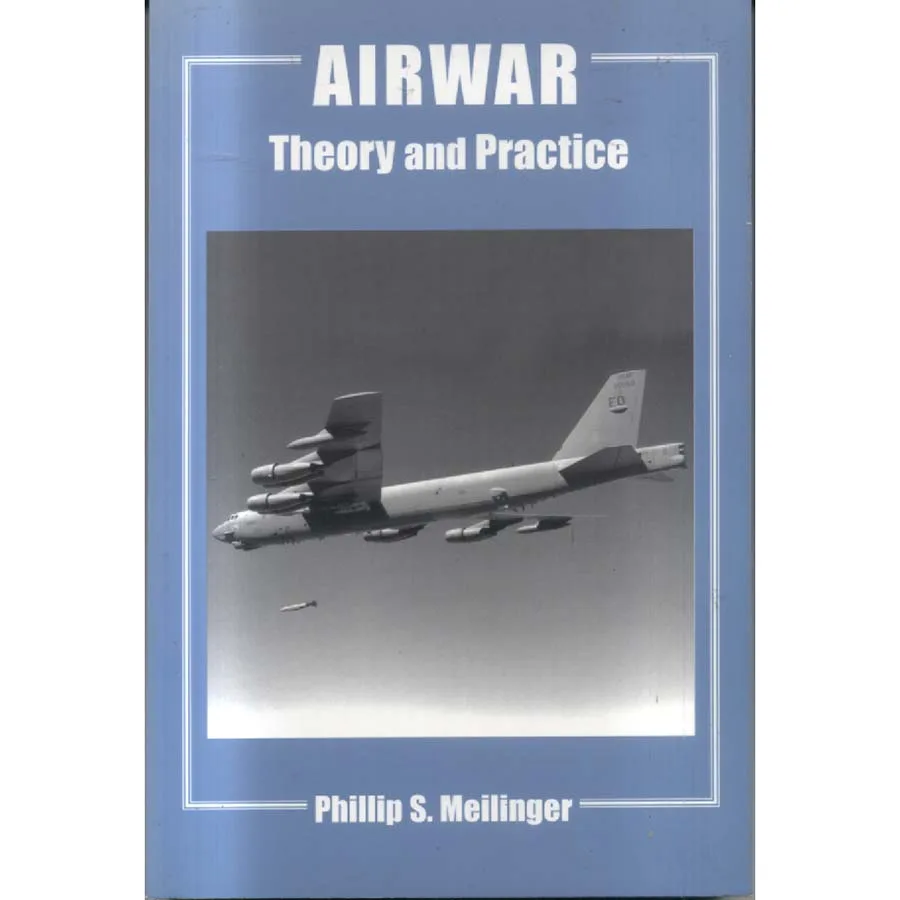
Publisher: Frank Cass
Format: Paperback
ISBN: 9780714682662
Since the first military aeroplane appeared above a battlefield, air-power advocates have promised speed, precision, strategic decision and victory without the tedious requirement of fighting through every field between home and the enemy capital. Their opponents have replied that aircraft cannot occupy territory, govern populations or persuade an army to surrender merely by producing an impressive briefing slide. More than a century later, the discussion remains airborne.
Airwar: Theory and Practice gathers Phillip S. Meilinger’s essays on the development, application and limitations of air power. Rather than offering a single chronological history, the book moves between influential theorists, aircraft design, inter-service rivalry, strategic bombing, targeting and modern precision warfare. Collectively, the essays examine whether air power transformed the nature of war or merely supplied war with a faster and more expensive method of continuing its traditional disagreements.
Meilinger begins with Giulio Douhet, the Italian theorist who argued that fleets of bombers could strike directly at an enemy’s cities and industry, break civilian morale and decide wars independently of armies and navies. Douhet’s ideas became enormously influential, partly because they offered air forces a strategic role and partly because every new military service appreciates a theory explaining why it should receive its own budget.
The development of British doctrine receives particular attention through Hugh Trenchard and John C. Slessor. Trenchard promoted offensive bombing and the belief that sustained attack could undermine enemy morale, although measuring morale proved rather harder than bombing it. Slessor developed the theory of air interdiction: attacking transport, supplies and reinforcements behind the battlefield so that enemy forces arrive late, hungry or preferably not at all.
The interwar Royal Air Force had to protect its institutional independence while politicians pursued disarmament and other services questioned whether aeroplanes deserved quite so much attention. Meilinger examines the Geneva Disarmament Conference and proposals to restrict bombing aircraft, demonstrating that nations were perfectly willing to abolish frightening weapons provided every potential enemy abolished them first and could be trusted indefinitely.
An essay on Britain’s Fleet Air Arm explores the awkward position of naval aviation between the Royal Navy and Royal Air Force. Sailors wanted aircraft suited to ships, airmen wanted control of anything that flew, and the aircraft themselves had no formal representation. The resulting decisions affected British carrier aviation as another world war approached with its usual disregard for peacetime organisational arrangements.
Technology and design choices in American fighter development provide another example of doctrine becoming metal. Speed, range, manoeuvrability, armament and protection all competed within aircraft that could not possess unlimited weight or unlimited money, despite occasional evidence that procurement officials had misunderstood the second restriction. A fighter’s design revealed what its air force expected the next war to look like, often several years before the enemy supplied corrections.
The Second World War essays examine air power in joint operations and the B-29 campaign against Japan. Air forces could strike factories, transport networks and cities on an unprecedented scale, but effectiveness depended upon intelligence, bases, logistics, weather, escort and cooperation with naval and ground forces. “Independent” air power remained surprisingly dependent upon fuel, maintenance and somebody capturing an island close enough to the target.
The B-29 represented a remarkable technological achievement: a pressurised, long-range bomber able to carry enormous loads across the Pacific. Its campaign also demonstrated the distance between doctrine and operational reality. High-altitude precision bombing encountered winds, cloud and mechanical problems, leading eventually to low-level incendiary attacks against Japanese cities. Precision remained the declared ideal while urban geography received the practical result.
Meilinger then turns to targeting: the question of what exactly air attack should accomplish. Destroying a bridge is tactically clear, but the strategic effect depends upon whether the enemy needed that bridge, could repair it or had another one nearby. Successful air strategy requires identifying the systems upon which an opponent depends and understanding how their disruption contributes to political objectives. Selecting something visible from the air is not, by itself, a strategy.
Modern precision weapons promised to transform this calculation. If a bomb could reliably strike a specific building, air forces might achieve decisive effects while reducing civilian casualties and unnecessary destruction. Meilinger takes precision seriously but also examines its limits. A weapon may hit precisely what planners selected and still produce the wrong result because the selected target was based on poor intelligence. Accuracy cannot compensate for confidently bombing the wrong building.
The collection considers gradual escalation, the practice of increasing military pressure in controlled stages to signal determination and encourage negotiation. This approach influenced American strategy in Vietnam, where limited bombing was expected to communicate political messages to North Vietnam. The messages were delivered in explosives, translated through different assumptions and did not always receive the reply Washington had requested.
Later essays examine Iraq, Kosovo and the post-Cold War idea of aerospace power. The 1991 Gulf War displayed air power’s ability to establish superiority, strike command systems and devastate conventional forces. Kosovo appeared to show that sustained air attack could help achieve political objectives without a major Allied ground campaign. Both cases encouraged expansive claims, because every successful military operation immediately produces a theory explaining why the winning component was solely responsible.
Yet Meilinger repeatedly stresses limitations as well as capabilities. Air power can move rapidly, strike deeply and apply force without fighting through intervening territory, but it cannot remove politics from war. Bombing remains a means rather than an objective. If political leaders do not know what outcome they seek, no degree of accuracy will cause the target coordinates to explain it to them.
Meilinger writes as both historian and experienced airman, combining operational knowledge with an interest in doctrine and institutional development. His arguments are broadly sympathetic to air power but not merely promotional. He examines the conditions under which aircraft succeed, the mistaken assumptions that lead to failure and the persistent danger of confusing tactical brilliance with strategic victory.
This is an excellent choice for readers interested in military aviation, strategic bombing, air-power theory and twentieth-century warfare. It covers thinkers, machines and campaigns while asking the question lurking beneath every photograph of an impressive aircraft: what, precisely, is it meant to achieve once it reaches the target?
This copy is in Good condition, showing ordinary signs of previous deployment but remaining entirely serviceable. Offered by Crappy Old Books, it is a thoughtful collection on the promises and limits of air warfare—where theory soars effortlessly, practice encounters anti-aircraft fire and somebody at headquarters insists the operation proceeded substantially according to plan.
Keep browsing: See more War books Other books by Phillip S Meilinger
